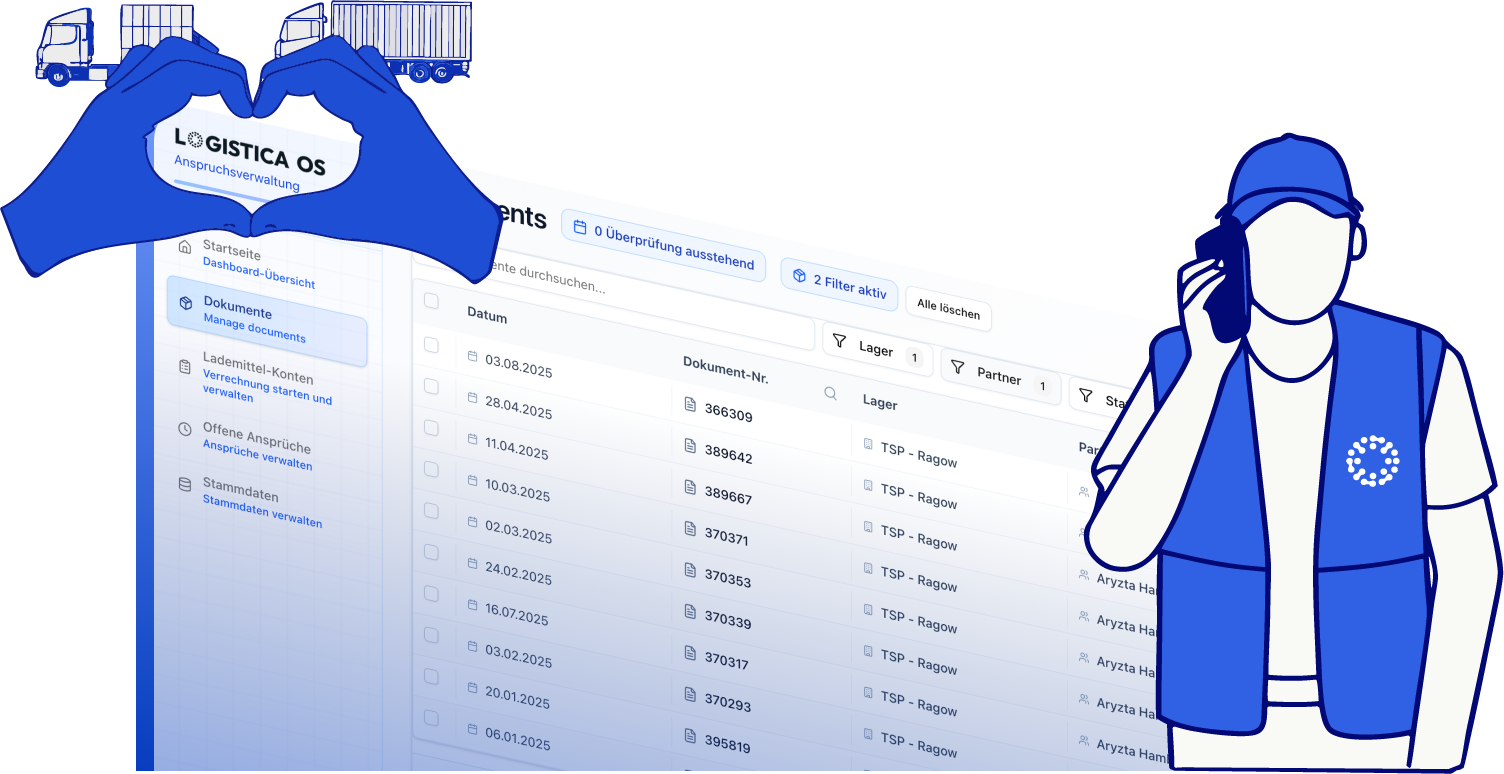
Why Pallet Admin is A Pain in the Ass
Learn why pallet accounting is the silent margin killer in freight logistics.

Before we started Logistica OS, we were busy building fliit, a digital freight forwarder for food logistics. Like most fast growing startups, we focused on customers, product and surviving the week. Pallet accounts and load carrier admin sat quietly in the corner, waiting for attention. And the day a large customer sent us a 70.000€ invoice that got our attention very quickly.
Why Pallet Accounting Matters in Logistics

Supply chains love standards. Everyone knows the shipping container. But inside warehouses and on trucks, the real heroes are (Euro) pallets and other load carriers like roll cages, IFCO containers and box pallets.
In Europe alone, about 700 million pallets change hands on a regular basis (source) and millions of companies participate in this exchange system. When freight is delivered, pallets are rarely exchanged one to one. Companies build up pallet debts and pallet credits over time. If you want clean pallet balances with your partners, you need to record every single exchange.
At fliit, we didn’t track pallet balances. We had a hundred other fires to put out. However, wooden pallets cost between 15 and 25 euros and if you cannot prove you exchanged the pallets, you have to pay. So when the invoice came, we had no proof and no choice. We paid. In a low margin business, that hurts.
When Excel Becomes the Job

Excel quickly became its own problem. Tracking pallets means reviewing piles of delivery slips by hand. Every slip looks different. Some have handwritten notes. Many arrive buried inside thick document bundles that need to be sorted before you can even start. It is slow, tiring work.
We ended up hiring people whose full time job was simply keeping track of pallet balances. And the tracking was only half of it. They also had to call partners, send emails, look for missing slips and chase down open claims.
Eventually we gave up and accepted the monthly pallet invoices as a cost of doing business. It sounds ridiculous today, but it is still normal for millions of companies.
Digital Delivery Slips
You might assume everyone is using digital delivery slips in 2025. In reality, only 5% (source) of logistics companies exclusively use digital delivery slips. Even when digital systems exist, companies still rely on physical slips for compliance reasons and because they fit naturally into daily routines. Drivers, warehouse teams and admin staff know how to work with physical documents. Forcing them to learn yet another app is not the answer. (That’s something we also have painfully experienced ourselves.)
Great technology should make life easier for frontline workers. It should feel natural, not like homework. With modern AI, we can finally build software that does exactly that.
In the next article, we will show how Logistica OS uses modern software and AI to remove the pain from pallet admin and load carrier management once and for all.
Subscribe below so you do not miss it.
Schedule a demo to see our agents in action