Agentic Document Processing in Logistics: Our Learnings
Despite digital systems, paper documents remain the reality in logistics. Modern AI models can process these complex documents with +90% accuracy, but success depends on proper implementation: the right context, continuous evaluation, and human-machine collaboration.
The Challenge: Digital Systems Meet Paper Reality
The logistics industry has made enormous progress in recent years: Transport Management Systems, Merchandise Management Systems, Warehouse Management – much is already digital. Some companies even use driver apps and digital delivery notes.
But reality often looks different: What actually happens (which goods were delivered, how many pallets were exchanged, what special circumstances occurred) is still documented on paper. Delivery notes, CMR consignment notes, pallet receipts, Bills of Lading, and other accompanying documents record what actually took place. These paper documents are usually indispensable, especially when exchanging loading equipment such as pallets, roll containers, or crates.
Why Traditional OCR Solutions Don't Work in Logistics
Automated document processing has existed for over 20 years in the form of OCR (Optical Character Recognition). The computer analyzes pixels in an image file and rigidly translates certain patterns into letters and numbers. Like a template that always works the same way.
The problem: In logistics, this method has limited applicability. The solution is too rigid, too expensive to set up, and not flexible enough for reality. No delivery note looks like another, handwriting and stamps are added, and different freight forwarders use completely different formats.
The Better Alternative: AI That Thinks
Modern AI models (so-called Large Language Models or LLMs) offer a fundamentally different approach. They have two decisive advantages:
- They understand not only text but also images: These models can work directly with scanned documents, photos of delivery notes, or PDFs without complex preprocessing.
- They understand context: This is the game changer: While traditional OCR only recognizes letters, AI understands the context. An example: If a document says "Received 15," does this refer to pallets or the delivered goods? And do I book the transaction to the load carrier account of the sender or recipient? A well-implemented AI can deduce this from the context.
This flexibility makes AI models significantly better at dealing with exceptions, unusual formats, and the diversity of real logistics documents.
What Problem Is Actually Being Solved?
Before implementing a solution, you should understand what kind of problem needs to be solved:
Standard tasks: Is it about processing large volumes of uniform documents from the same partners, always in the same format, with little handwriting? In these rare cases, traditional OCR solutions may suffice. However, this is the absolute exception in logistics.
Tasks "with intelligence": Is it about handwriting, stamps, different formats, and does context need to be understood? Then modern AI models are the right choice. They can not only extract data but also correctly classify it based on the proper context.
The Key to Success: The Right Context
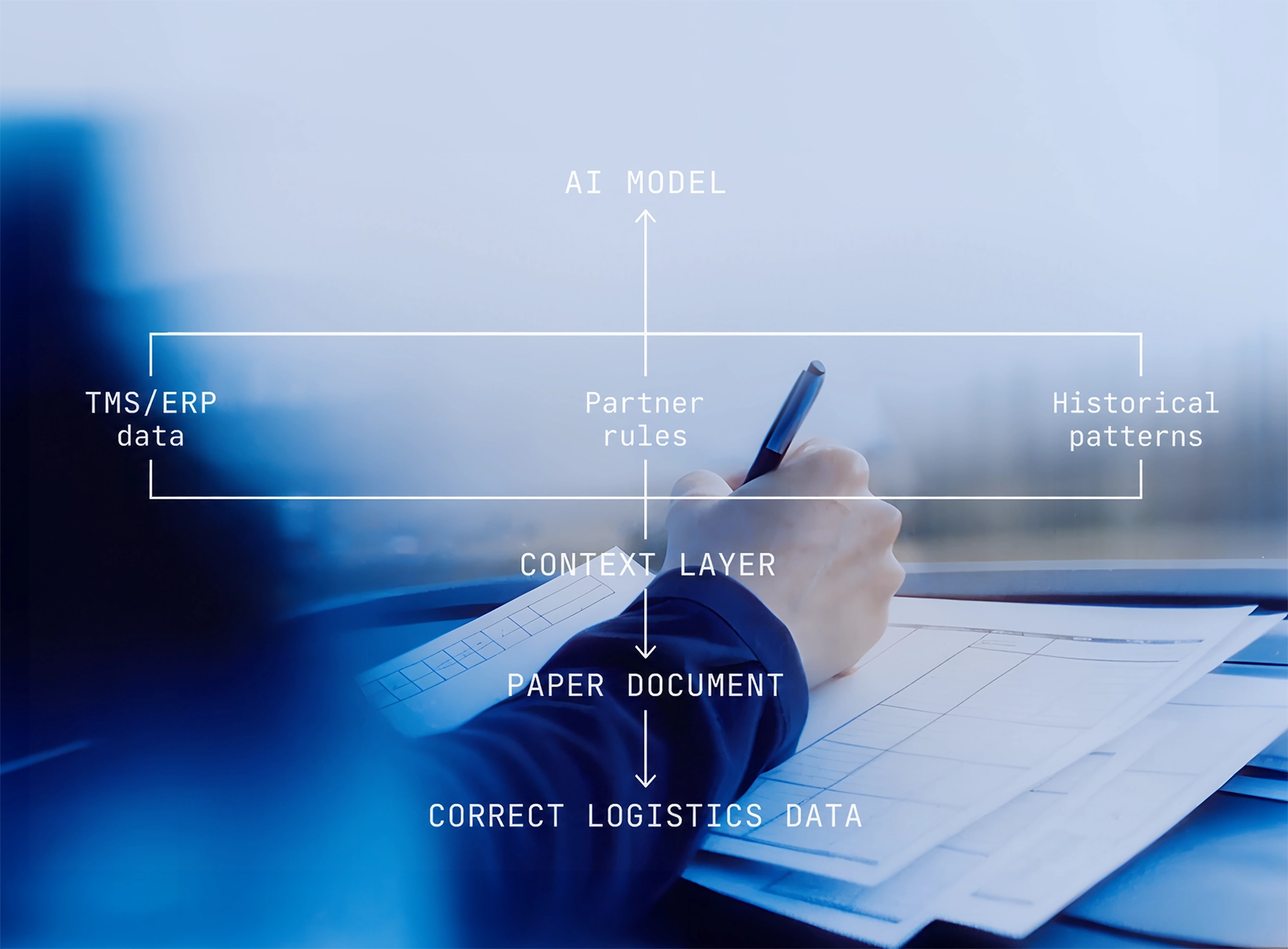
For AI models to work properly in a specific logistics environment, they need the right context, similar to how a new employee needs to be trained. We call this "Context Engineering."
This involves providing the model with relevant additional information:
Data from existing systems: Information from the Transport Management System or ERP can help the model correctly assign information on documents – even when incomplete.
Company knowledge: Special agreements with customers, abbreviations and customer-specific terms, historical cases – all the tribal knowledge that "sits” in the company can help the model make better decisions.
Accompanying documents: In logistics, documents often come in bundles. Sometimes only the combination of delivery note, pallet receipt, and pooling document provides the complete picture, for example in load carrier management.
Important: More is not always better. Too much information can overwhelm the model and worsen results. The art lies in providing as little as possible, but as much as necessary.
The Danger of "Autopilot"
An important point: AI models tend to take the easiest path. If they know a similar case from the past, they often treat new documents the same way – even if there are differences this time.
That's why it's so important to find the right balance: Enough information for the model to learn, but not so much that it stops evaluating each case individually.
How Do We Ensure It Works?
Context Engineering is a continuous process, not a one-time setup. That's why our teams work closely with you, especially in the initial phase, but also afterward.
A central tool is so-called "Evaluations" (or "Evals"). We systematically test how well the AI works: We take a stack of real documents, have the AI process them, and compare the results with the correct values we already know.
Why is this so important? Because you can't assume that a solution that works perfectly at Company A will automatically deliver the same results at Company B. Each company has its own context, its own partners, its own documents. This reality is underestimated by many standard software providers who only offer AI as an additional feature.
Which AI Models Are Available?
Various AI models for document processing are available on the market:
Commercial models: Providers like OpenAI(ChatGPT), Google (Gemini), or Anthropic (Claude) offer very powerful models that are immediately ready for use.
Open-source models: Alternatives like Mistral or Qwen can be self-hosted – meaning more control, but also more effort.
The choice depends on several factors: budget, required speed (how quickly must documents be processed?), and security requirements (how sensitive is your data?).
Our experience shows: Commercial models are very powerful when properly implemented and adapted to your context. The question is: Is it worth the significantly higher effort to host and manage your own open source model, or should you invest those resources somewhere else?
Nothing Is Perfect: Humans Remain Important
AI models don't work deterministically like a mathematical formula, but probabilistically. They predict the most likely outcome. This means: Despite the best preparation, context engineering, and continuous monitoring, the results will never be 100% correct.
This is not a flaw but inherent to the technology. That's why it's crucial that users can:
- Understand how the AI arrived at its result
- Have transparency about cases where the AI is uncertain
- Easily correct when something isn't right
With our first AI agent for load carrier management and claims, users can always review the model's information and correct it via a simple input form if needed.
The best part: The system learns from these corrections. With each piece of feedback, it gets better and makes fewer mistakes next time. It's a continuous improvement process.
Conclusion: AI Can Get the Job Done
AI-based document processing is not wizardry or futuristic technology – it's available today and can noticeably ease your daily logistics operations.
The key to success lies not in the technology alone, but in proper implementation: the right context, continuous monitoring, and collaboration between humans and machines.
If you deal with paper documents daily, need to process different formats, then it's worth taking a close look at modern AI solutions like Logistica OS.
Schedule a demo to see our agents in action